

Why Diesel engines play an important role, now and in future. Plus: Why they need special care year-round
Published
Modern diesel cars remain justifiably popular around the world. They run quietly, are economical and perform well on emissions. Their power and fuel efficiency also make them an ideal choice for commercial vehicle fleets. Diesel engines therefore remain a significant Aftermarket opportunity, and an area of technological investment for the world’s number one glow plug provider.
Advantages of diesel driving
Diesel vehicles offer a range of advantages to drivers and fleet owners. In terms of long-distance fuel economy for example, no combustion engine comes close. On average, diesel vehicles deliver between 20 to 30% better fuel economy than their petrol equivalents. This means that though they are initially more expensive to buy, going diesel saves money in the long run. In addition, diesels have more ‘pulling power’ than petrol engines. Kai Wilschrei, Senior Manager Technical Services Aftermarket EMEA at NGK SPARK PLUG EUROPE explains: “Diesel engines produce higher levels of torque at lower revolutions per minute (RPM), compared to a petrol engine. The more torque – or rotating force – an engine’s crankshaft produces, the greater its working efficiency. | The year-round role of glow plugs
|
Lower CO2 Emissions
In respect of carbon dioxide emissions too, diesel is a far better option than petrol – typically producing 20% less CO2. “If the goal is reducing CO2, diesels still play a major role in reaching these targets,” advises Wilschrei. The engines’ NOx emissions are also lower than ever. “Many diesel vehicles built in recent years are equipped with Selective Catalytic Reduction (SCR) technology,” he says. “This injects tiny quantities of AdBlue – a liquid solution of urea – into the diesel exhaust gases, transforming 85% of the NOx present into harmless water vapour and nitrogen.”
Indeed, independent studies carried out by German automobile association the ADAC on the latest 6c and 6d TEMP diesel models from car manufacturers like Mercedes-Benz, Opel and BMW revealed that most of the tested cars had NOx emissions which were significantly below the 168 mg/km currently permitted by Euro 6d-TEMP rules. Some of the cars tested emitted less NOx than their petrol equivalents. According to the ADAC, the Mercedes C-Class C220d was even found to emanate a barely measurable amount of less than 1 mg NOx during road tests.
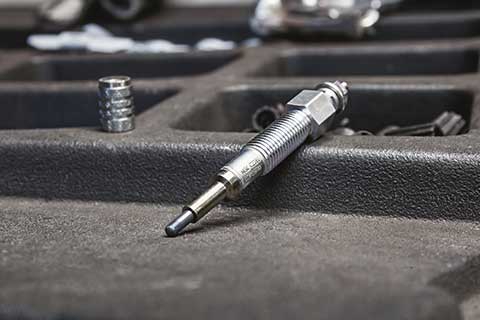
The basic role of glow plugs
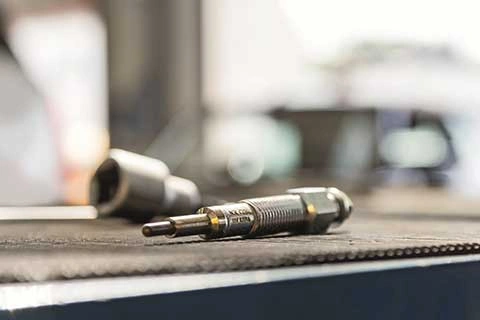
Unlike petrol engines which need a spark plug to ignite, diesel engines self-ignite. Air is drawn into the engine cylinders and greatly compressed, rapidly reaching temperatures of up to 900°C. When fuel is injected, it spontaneously ignites. In cold conditions, however, heat escapes to the cylinder walls, preventing ignition. The additional heat required is provided by glow plugs.
“They act just like an immersion heater,” confirms the expert. “The so-called ‘pre-glow’ generates the temperature boost that all diesel engines need in order to get going in cold weather.”
Aftermarket opportunities
The company’s OE quality product line is designed to deliver exceptional sales opportunities for the Aftermarket. “We offer every key glow plug technology and cover 4,000 applications – equivalent to 86% of vehicles in Europe. That means there is almost always an NGK glow plug specifically engineered to optimise each customer’s car” says Thorsten Schmeing, Product Manager Aftermarket EMEA.
“We at NGK SPARK PLUG believe in the continued potential of diesel and the expanding role glow plugs play in reducing emissions. We are committed to investing in R&D to enhance our product portfolio even further. Glow plugs are and will be an important sales opportunity for the Aftermarket, now and in the future”, concludes the expert.

Top three glow plug maintenance tips for all year reliable function
Find more advice at www.tekniwiki.com |
 Niterra Press Releases

44 new NTK MAF sensors expand EMEA vehicle coverage
Read more
Latest Articles
NGK Ignition Parts launches intelligent sensor technology in advanced glow plug - June 2026
NGK Ignition Parts expands spark plug portfolio to increase coverage in motorcycle and specialised applications - May 2026
NGK Ignition Parts powers up spark plug range: 26 new products for ICE and hybrid cars, from Porsche to Dacia - May 2026
NGK Ignition Parts extends ignition coils range with fourteen new references - April 2026
AHEAD’s loyalty programme propoints expands with addition of products from ElringKlinger and Nissens Automotive - February 2026