




Exhaust gas & differential pressure sensors (EDPS) under the spotlight
Published

One such component is the exhaust gas & differential pressure sensor (EDPS). This compact sensor monitors exhaust gas pressure and the level of soot build-up in the diesel particulate filter (DPF). It then provides real-time data to the engine control unit (ECU) to ensure the proper performance of the emission-control system.
Niterra’s NGK Ignition Parts and NTK Vehicle Electronics brands have a long history of developing components that optimise combustion-engine efficiency. NTK Vehicle Electronics sensors play a key role in monitoring and managing exhaust emissions within vehicle powertrains. One such component is the exhaust gas & differential pressure sensor (EDPS). This compact sensor monitors exhaust gas pressure and the level of soot build-up in the diesel particulate filter (DPF). It then provides real-time data to the engine control unit (ECU) to ensure the proper performance of the emission-control system.
Types of EDPS
NTK Vehicle Electronics’ EDPS range offers three such sensors: the differential pressure sensor (DPS), the exhaust pressure sensor (EPS), and the high-pressure sensor (HPS). Essentially, the differential pressure sensor (DPS) gauges the pressure drop between two positions in the exhaust flow pattern. This sensor can be sited at various locations in the exhaust manifold, such as before or after the DPF, the catalyst, a turbocharger, or the exhaust gas recirculation (EGR) valve. Its position determines whether it controls the exhaust gas recirculation or monitors the pressure difference over the DPF and reports that back to the control unit. The EPS also measures gas flow pressure and passes this data to the ECU.
It can generally be found in front of the DPF or mounted on either side of the turbocharger, if a vehicle has one. The HPS is principally tasked with measuring the back pressure of exhaust gases and preventing damage due to excessive pressure in the exhaust system. In this way, it sends information to the ECU to safeguard the condition of the turbocharger. Therefore, it is often found either on one of the two sides of the turbocharger, in front of the DPF, or after the EGR cooler. With two EPS sensors, the pressure drop between two positions in the flow pattern can also be determined.
All three sensors, together with the ECU, are vital in ensuring that an engine not only operates optimally but also produces as clean and environmentally friendly emissions as possible, and, very importantly, that the DPF and turbocharger are protected. Broadly speaking, the sensors are required to provide the ECU with the necessary information regarding the exhaust gas pressures.
EDPS can generally be found in a variety of motorised vehicles including cars, buses, trucks and agricultural and all-terrain vehicles.
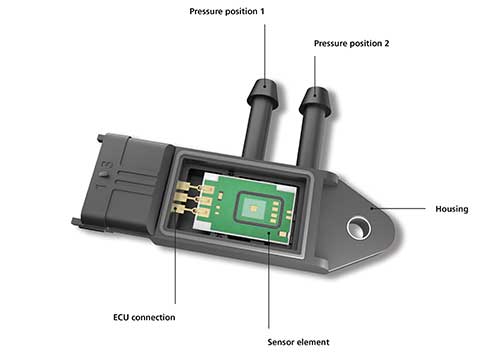
The EDPS and its market coverage
The efficient performance of essential engine parts depends heavily on these small, yet vital, components. This is why Aftermarket customers consistently turn to NTK Vehicle Electronics’ EDPS for their exceptional reliability and durability. This trust has not only made NTK a reliable choice but also a leader in the EDPS Aftermarket with a remarkable 62% coverage of the EMEA car parc, which equates to 87 million vehicles in total. This includes 42.3 million vehicles in Central Europe, 36.8 million in Western Europe and 7.6 million in the Middle East and East Africa. This figure is anticipated to grow significantly as more new vehicles are equipped with these sensors, driven by the need to comply with increasingly stringent EU emissions regulations. Additionally, while EDPS are nowadays primarily found in diesel vehicles, their installation in petrol cars is on the rise, which is expected to further accelerate market growth in the coming years.
The importance of maintenance with EDPS
The first indication that there is an issue with an EDPS will likely come from the engine control light. In either case, it is best to seek out a qualified mechanic, garage or workshop. Proper maintenance and timely replacement of the EDPS is therefore crucial.
Further signs that the sensors are malfunctioning may include unnecessary regeneration of the DPF and a decrease in vehicle performance caused by filter oversaturation. This, in turn, can lead to issues with the turbocharger, potentially resulting in increased oil consumption.
Conclusion
This feature represents the final article in a series from Niterra that provides essential background information on the key technical specifications of high-tech components from the company’s NGK Ignition Parts and NTK Vehicle Electronics brands. Previous articles in the series cover other items offered by the brands’ extensive ranges can be found under Niterra Feature - Insights and Background Information.
For further information on NTK Vehicle Electronics brands’ EDPS, please visit TekniWiki under www.tekniwiki.com. This is a technical platform with interactive learning modules that is continuously being updated to meet the most recent user requirements. Additionally, the EDPS line from NTK is accompanied by our technical video: